
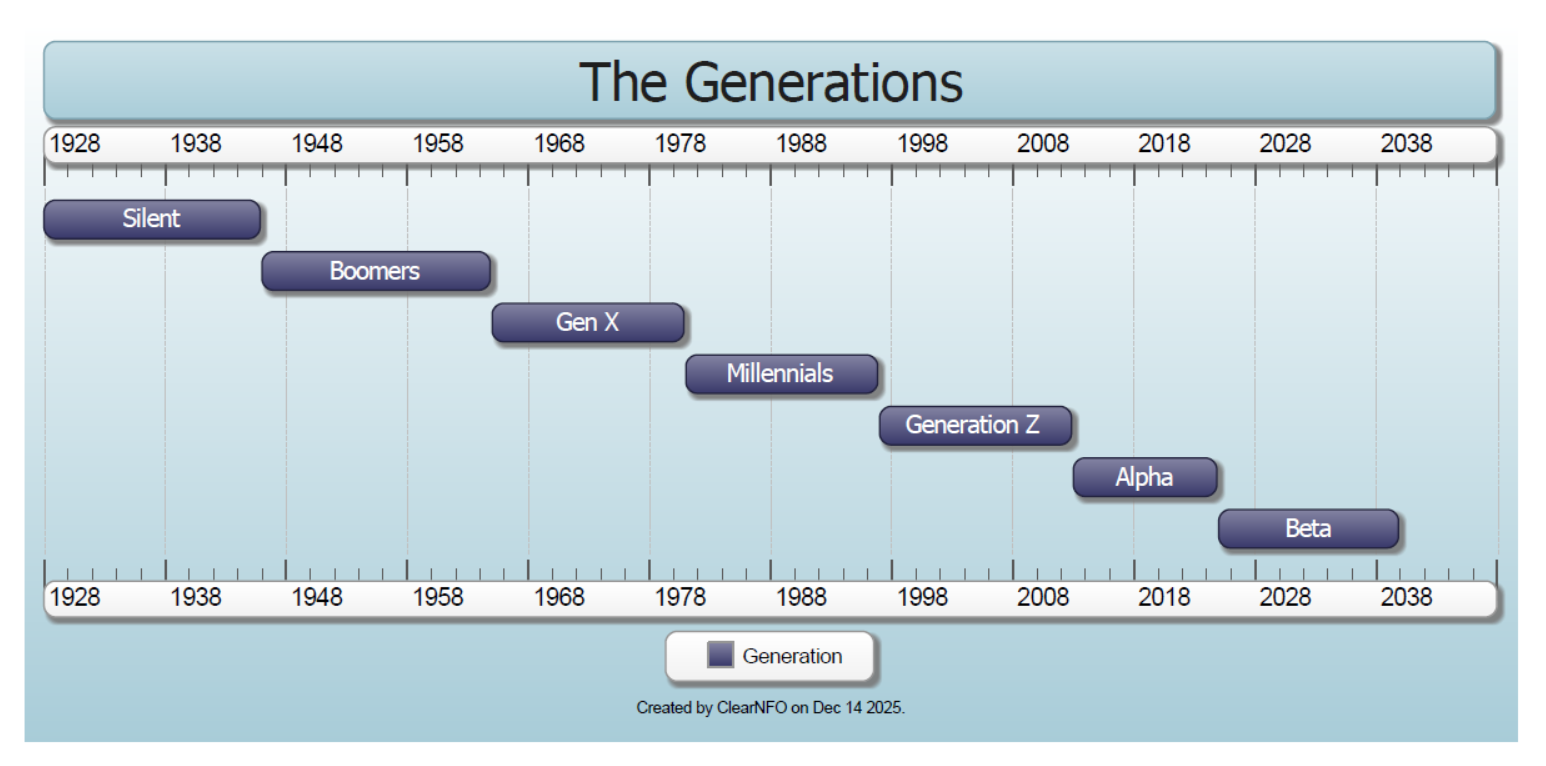
Generations
- Silent Generation (or Traditionalists): Born 1928–1945
Shaped by the Great Depression, World War II, and post-war economic growth.
- Baby Boomers: Born 1946–1964
Named for the post-WWII “baby boom”; experienced civil rights movements, Vietnam War, and economic prosperity.
- Generation X (Gen X): Born 1965–1980
Often called the “latchkey” or “MTV generation”; grew up during the end of the Cold War, rise of personal computers, and shifting family structures.
- Millennials (or Generation Y): Born 1981–1996
Came of age around the new millennium; influenced by the internet boom, 9/11, and the Great Recession.
- Generation Z (Gen Z or Zoomers): Born 1997–2012
True digital natives; shaped by smartphones, social media, and events like the COVID-19 pandemic. (Note: see Jared Cooney Horvath’s comments below.)
- Generation Alpha (Gen Alpha): Born 2013–2024
Children of Millennials; the first generation born entirely in the 21st century, growing up with advanced AI, tablets from infancy, and the pandemic.
- Generation Beta (Gen Beta): Born 2025–2039 (starting now in 2025)
The newest cohort, primarily children of younger Millennials and Gen Z; expected to be deeply integrated with AI, automation, and global challenges like climate change.
USA: population distribution
Silent Generation (born 1928–1945, ages 80–97): The smallest adult generation due to historical low births and aging. Approximate living population: ~18–20 million (about 5–6% of the population; many now in the 80+ category).
Baby Boomers (born 1946–1964, ages 61–79): Still a large group, though declining due to mortality. Approximate living population: ~68–70 million (about 20% of the population).
Generation X (born 1965–1980, ages 45–60): A relatively smaller “bridge” generation. Approximate living population: ~65 million (about 19% of the population).
Millennials (born 1981–1996, ages 29–44): The largest adult generation. Approximate living population: ~74 million (about 21–22% of the population).
Generation Z (born 1997–2012, ages 13–28): A sizable and diverse cohort entering adulthood. Approximate living population: ~69–70 million (about 20–21% of the population).
Generation Alpha (born 2013–2024, ages 1–12): Growing rapidly but still young; US birth rates are lower than global averages. Approximate living population: ~39–42 million (about 11–12% of the population).
Generation Beta (born 2025–2039, ages 0): Just beginning. Approximate living population: ~3–4 million (births from January to December 2025; annual US births are around 3.6–3.7 million).
GLOBAL: population distribution
Silent Generation (born 1928–1945, ages 80–97): Combined with pre-Silent cohorts in the 80+ group. Approximate living population: ~165 million (about 2% of global population).
Baby Boomers (born 1946–1964, ages 61–79): Approximate living population: ~1.06 billion (about 12.8% of global population).
Generation X (born 1965–1980, ages 45–60): Approximate living population: ~1.2–1.4 billion (about 15–17% of global population; often grouped with working-age adults).
Millennials (born 1981–1996, ages 29–44): Approximate living population: ~1.7–1.8 billion (about 21–23% of global population).
Generation Z (born 1997–2012, ages 13–28): Approximate living population: ~1.9 billion (about 23% of global population; Gen Z + Millennials ~44%).
Generation Alpha (born 2013–2024, ages 1–12): Approximate living population: ~2.0 billion (about 24.4% of global population; the largest cohort, surpassing all others).
Generation Beta (born 2025–2039, starting in 2025, ages 0): Approximate living population: Very small (less than 1 million as of December 2025; only births from January to December 2025).
Gen Z
“Our kids are LESS cognitively capable than we were at their age.”
Every previous generation outperformed its parents since we began recording in the late 1800s.
So, what happened?
Screens.
Dr. Jared Horvath explained:
“Gen Z is the first generation in modern history to underperform us on basically every cognitive measure we have, from basic attention to memory, to literacy, to numeracy, to executive functioning, to EVEN GENERAL IQ, even though they go to more school than we did.”
“So why? … The answer appears to be the tools we are using within schools to drive that learning (screens).”
“If you look at the data, once countries adopt digital technology widely in schools, performance goes down significantly, to the point where kids who use computers about five hours per day in school for learning purposes will score over two-thirds of a standard deviation LESS than kids who rarely or never touch tech at school. And that’s across 80 countries.”
But screens aren’t just decimating learning and making new generations less intelligent than the ones before them. (Source: https://x.com/thehealthb0t/status/2019717847992443239?s=20)
About Jared Cooney Horvath: Helping teachers, students and educators achieve better outcomes through applied brain science and cognitive psychology. JARED COONEY HORVATH | PhD, MEd Dr. Jared Cooney Horvath is an award-winning cognitive neuroscientist, best-selling author and renowned keynote speaker with an expertise in human learning, memory, and brain stimulation. Dr. Horvath has published 6 books, over 50 research articles, and currently serves as an honorary researcher at the University of Melbourne and St. Vincent’s Hospital in Melbourne. His research has been featured in popular publications including The New York Times, WIRED, BBC, The Economist, PBS’s Nova and ABC’s Catalyst. https://www.lmeglobal.net/media
https://www.youtube.com/c/JaredCooney/videos