ClearNFO Rating: 2 / 5 Stars
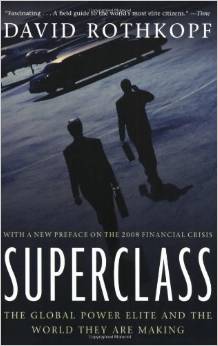
SUPERCLASS: The Global Power Elite and the World They Are Making
by David Rothkopf (March 3, 2009)
Paperback 361 pages
Available at Amazon and other book resellers
 On this review, I venture into the world of the establishment to read about the SUPERCLASS in the hope of uncovering some heretofore unknown pearl of wisdom or unexplored fact. So … how establishment is Mr. Rothkopf anyway? Very, with favorable reviews from the likes of Time, The Economist and Joseph E. Stiglitz you can bet Rothkopf is a ‘made-man’ and would be invited to Davos and other elite gatherings. He is part of the establishment for sure and it is unseemly important to him that you understand this simple fact ad nauseam. But more to the point, he is a member of the CFR (Council on Foreign Relations), ex-managing director of Henry A. Kissinger’s Kissinger Associates and was part of the Clinton Administration in 1993 as Deputy Under Secretary of Commerce for International Trade Policy and Development.
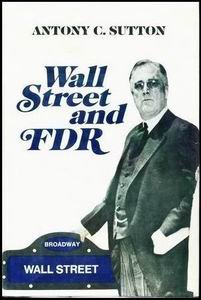
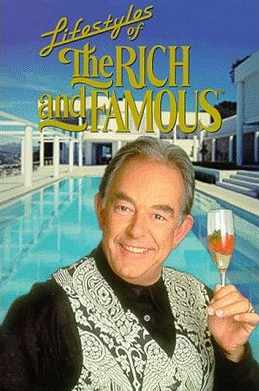
If you are looking for facts and new information on the truly elite, your time would be better spent with Carroll Quigley’s The Anglo-American Establishment or one of Anthony C. Sutton’s books than with Rothkopf’s ‘SUPERCLASS’. ‘SUPERCLASS’ in my view is akin to a pleasant vacation with Robin Leach of Lifestyles of the Rich and Famous. David Rothkopf is a brilliant writer and very knowledgeable about rich and powerful but unfortunately, he confuses the wealthy and powerful technocrats who are minding the garden, with the truly elite who control the technocrats. How this is accomplished is brilliantly exposed in Quigley’s ‘Anglo-American Establishment’.
 Despite Rothkopf’s obvious intelligence and his establishment credentials, it is clear to me that he has never had the benefit of reading any of Carroll Quigley’s excellent work documenting the real power brokers Quigley called the ‘network’; or if he has, has chosen not to communicate the real sources and methods of the network of control; rather, he seems dazzled by the rich and powerful CEOs and the kings, queens and dictators of the world, not realizing that Quigley’s network need neither money nor title to exert its power and influence as demonstrated by the Milner group, now almost extinct. So what we have with this book is a book not about the ‘Super-duper’ Superclass but a book about their technocrats who manage the estate for the real superclass.
I found this reader-review from Palo Alto on Amazon particularly insightful and common. Because of Roghkopf’s need to belong to the power-elite, he seems to have missed the very point of his own book:
This book takes a LOT of time to say very little. In summary, here’s what the author takes several hundred pages to tell us:
a) The world is ruled by an informal group of about 6,000 people;
b) I [the author] am one of them! Aren’t I special?
c) I know who the others are—but I’m not going to tell you!
d) They all get together once each year in Davos;
e) Davos is quaint, and has good restaurants, but inadequate lodging; and,
f) Oh, did I forget to tell you? I’M one of the Davos world elite! I AM special!
Had I not read Quigley’s ‘Anglo-America Establishment’, I would likely be subject to the same limited view that we find in SUPERCLASS; that is, I would be without the ability to see past the CEO or Monarch into the real power structure they serve. I call this limited view, the Walled-Garden of History and Politics where the establishment players and the unwashed masses are allowed to play within the walls surrounding the garden as long as there is a tacit agreement to certain unexamined assumptions. The Walled-Garden’s walls are mostly invisible but retain their structure and are created from the assumptions we take for granted as well-established facts and thus most of us including David Rothkopf never take the time to reexamine these assumptions for consistency against Empirical evidence. For example, there are many misstatements of fact: J.P. Morgan and Jamie Diamond did not help rescue the financial markets in their day; rather they were both part of the problem and in J.P. Morgan’s case created the problem that he later received credit for solving; and the IMF is not about helping the poor and underdeveloped countries as Rothkopf would have us believe. And to rescue the SUPERCLASS from all the conspiracy theorists, Rothkopf digs up the discredited Jewish straw man conspiracy by ridiculing the tin foil hat wearers for thinking that the Jews are responsible for the secret societies and hidden groups who really control the world. After all –Rothkopf reasons– Hitler exterminated quite a few of the Jews how silly is it to say then that the Jews are behind this hidden conspiracy? Of course I have never thought the Jews were behind Quigley’s network and no serious open –source investigator has either; so Rothkopf scores an empty point for the establishment. Though many in the original Milner network were Jews, not all were and their Jewishness had nothing to do with their position of power. A better use of Rothkopf’s time and energy and his great facility with the English language would be to discover the real source and methods used by the ‘Anglo-American Establishment’ and then provide an update on their current intellectual progeny.
BACKCOVER: Each of them is one in a million. They number six thousand on a planet of six billion. They run our governments, our largest corporations, the powerhouses of international finance, the media, world religions, and, from the shadows, the world’s most dangerous criminal and terrorist organizations. They are the global superclass, and they are shaping the history of our time.
Today’s superclass has achieved unprecedented levels of wealth and power. They have globalized more rapidly than any other group. But do they have more in common with one another than with their own countrymen, as nationalist critics have argued? They control globalization more than anyone else. But has their influence fed the growing economic and social inequity that divides the world? What happens behind closeddoor meetings in Davos or aboard corporate jets at 41,000 feet? Conspiracy or collaboration? Deal-making or idle self-indulgence? What does the rise of Asia and Latin America mean for the conventional wisdom that shapes our destinies? Who sets the rules for a group that operates beyond national laws?
Drawn from scores of exclusive interviews and extensive original reporting, Superclass answers all of these questions and more. It draws back the curtain on a privileged society that most of us know little about, even though it profoundly affects our everyday lives. It is the first in-depth examination of the connections between the global communities of leaders who are at the helm of every major enterprise on the planet and control its greatest wealth. And it is an unprecedented examination of the trends within the superclass, which are likely to alter our politics, our institutions, and the shape of the world in which we live.